
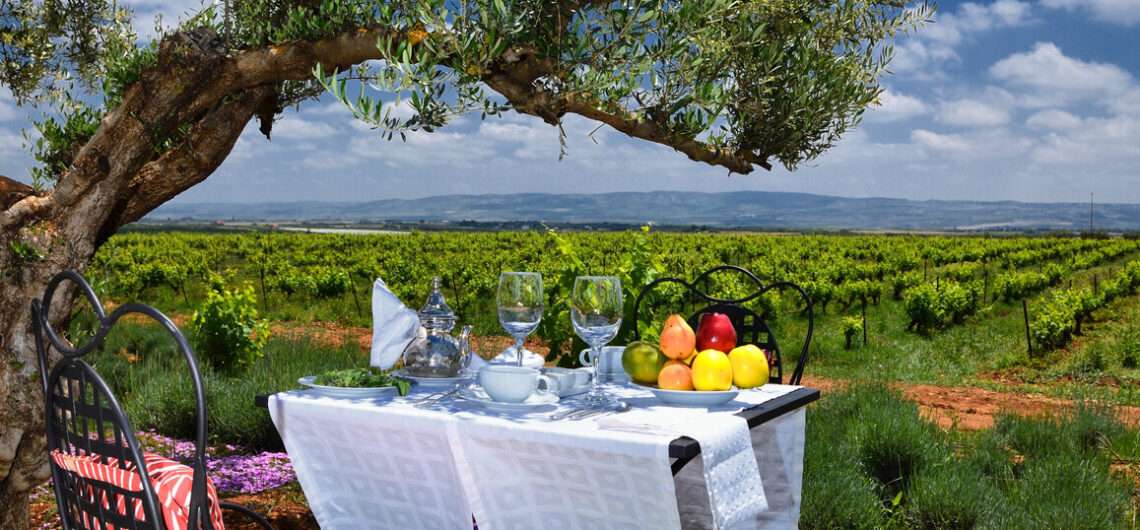
The viticulture in Morocco and the planting of the first vineyards date back to the Phoenicians and the Roman colonisation. In ancient times, the major centre of wine production was concentrated around Volubilis. This region is part of the present-day city of Meknes.
Morocco remains one of the last lands wild vines on earth. As early as antiquity, Pausanias the Periegete noted that the inhabitants of Lixus, a city founded by the Phoenicians on the right bank of the Loukkos wadi, consumed the fruit. Louis Levadoux indicates that ‘The Berbers do not neglect this supplement.’ Indeed, when autumn comes, the people of Guergour go high up into the forests of the Atlas. They pick the grapes from the trees to eat them fresh or dry them on racks.
Click here, to book a place with us for a winery tasting tour.
The ampelographer was able to find, in the valley of the Oued Titria, these lambrusques known as Aneb djalia. He notes that “Some of them bear a strong resemblance to the grape varieties cultivated by the Berbers”.
The first wines were produced around the second century BC during the installation of Phoenician and Greek trading posts.
It was the Roman colonisation that developed viticulture in Morocco, allowing the wines of Mauritania to be presented on the patrician tables. This province corresponded to the northern part of present-day Morocco. It extended from the north, to Salé , to Volubilis in the south, and to the east in the Oued Laou river. The main cities were Volubilis, Tingis (Tangier), Lixus (Larache) and Tamuda (Tetouan).
The Muslim conquest did not make the North African viticulture disappear but rather privileged the table grape. The Moroccan, Islamized, Berbers brought their varieties when they arrived in the Iberian Peninsula. One of these is still cultivated in Andalusia. It is the white Faranat of Tunis, known in Spain as Majorcan. In Al Andalus, many Muslim agronomists described viticulture and its different Andalusian grape varieties. They detailed their cultivation methods. Additionally, the vineyards continued to produce wine, to which was added palm wine. This wine was made from dried grapes and considered not prohibited. All the emirs and caliphs of Moorish origin were great drinkers. The palaces of Granada, Cordoba, Seville, Medinaceli, and Almeria were famous for their wines and the drinking that took place there.
In Morocco, the various Muslim rulers tolerated the Jewish communities that resided in their neighborhoods, the mellah. It was there that Jews could drink wine but were forbidden to sell it. Many had their own vineyards. Al Hasan Ibn Muhammad Al Zayyati Al Fasi Al Wazzan, known as Leon the African, noted in 1525 that in Taza, this was the case for five hundred families. In addition, the communities settled in Demnate, Mogador, and Marrakech had the same rights of ownership and vinification.
The same licenses were granted to resident Christians. They were firstly given to the Sultan’s mercenaries, a militia created as early as the seventh century, and secondly to the consular corps. At the beginning of the fourteenth century, the members of the Genoa Consulate had Fondouks in Ceuta, Arzila, Larache, Salé, and Anfa. The taverns sold wine from the countries of the northern Mediterranean. In the statutes of Marseille, 1228, it is mentioned that the Manduel sell wine from Provence in Ceuta. In the 16th century, Leon the African estimated the number of these drinking establishments in Fez at two hundred. He also noted that “some men had wine for sale in their homes. Each man could use it in peace without the court taking offense.”
In Portuguese Morocco (August 15, 1415 – March 11, 1769), the Portuguese planted vines when they settled in Azemmour, Safi, and El Jadida. This was a foreshadowing of today’s Doukkala vineyards.
For the Moroccan Jewish community, wine production continued until the 20th century and vines were grown in the gardens. However, it was reported that at the end of the protectorate the quality of this kosher was unsatisfactory. “Kosher red wine is abominable, especially the Dahlia wine made by the cousin Salomon Amar.” There was no valid kosher wine production.”
With the colonization of the 20th century, the French developed viticulture in Morocco as well as in Algeria and Tunisia. As phylloxera had ravaged most of the European vineyards by 1875, vineyards were created in North Africa by French merchants to supply themselves with wine. They were quickly joined by their Spanish and Italian colleagues.
In Morocco, the choice of land was preponderant. The vines planted in the sandy soils of the Chaouïa, Trifas, and Sahels regions were resistant to disease, as the insect could not live in the sand. Some French grape varieties were grafted, and the culture became intensive. From 1880, whole boats arrived in Europe loaded with grapes. By 1905, the first pinardiers left Casablanca and unloaded in European ports.
Four grape varieties had been selected as being the most suitable for the terroirs to produce the desired wines. These were Grenache, Carignan, Cinsault and Alicante Bouschet. This marked the beginning of the mass production of Moroccan viticulture. It was also the era of high-grade medical wines used in blending. Before the First World War, 80,000 hectares were cultivated with vines. This offered them a large outlet. Production was then based on volume rather than quality. Many Moroccan wines were sent to Languedoc to enrich the alcohol content of the table wines. This choice of grape varieties from the Midi and Spain, large producers, was introduced by the colonists.
In 1923, a Belgian company set up a winery near Ben Slimane in the Casablanca region. The first harvest took place in 1927. This marked the beginning of modern Moroccan viticulture. Thalvin-Ebertec is the owner of this estate, which bears the name of Ouled Thaleb.
In this period of prosperity, the vineyard area exceeded 55,000 hectares. The production was 3,500,000 hectoliters. Domains of several hundred hectares existed around Meknes, Rabat, Tiflet, and Khemisset. The cellar of Aït Souala, in Meknes, remains the witness and symbol of this euphoric period.
By the end of the 1950s, the area planted with vines exceeded 65,000 hectares and more controlled yields had reduced production to 3,000,000 hectoliters.
In 1956, with independence, the Moroccan kingdom inherited these wineries and vineyards, but viticulture reduced its hold for both cultural and religious reasons.
In addition, in 1967, the Treaty of Rome prohibited the blending of European community wines with those from abroad, and Morocco lost this market and faced a crisis of overproduction.The vines were uprooted and the cellars closed, the viticulture fell into decay.
However, this measure gave a new impetus to Moroccan production, they’ve forced wine growers to abandon the bulk to turn to the bottle. This was the appearance of modern production units where they made more qualitative grape varieties as chardonnay, roussanne, syrah, cabernet…
In the early 2000s, 12,000 hectares were cultivated for a production of between 350,000 and 450,000 hectoliters.
The region of Meknes alone representing nearly half of the Moroccan vineyard. This period is marked by the arrival of the French Castel and the creation of the Domaine de la Zouina. The official laboratory for chemical analysis and research for wine is located in Casablanca. Since then, Morocco is a member of the International Organization of Vine and Wine. In 2008, it produced 35 million bottles.
Since 2011, the new government , has created another political climate that is less favorable to wine consumption by Moroccans themselves. The increase in taxes on alcoholic beverages had a bad effect, since 85% of the production locally.
Despite this restrictive policy, wine remains a booming economic sector, with a production of over 40 million bottles per year. This makes Morocco the second largest wine producer in the Arab world. In addition, the wine sector generates 20,000 jobs and brought, in 2011, 130 million euros.


Comments